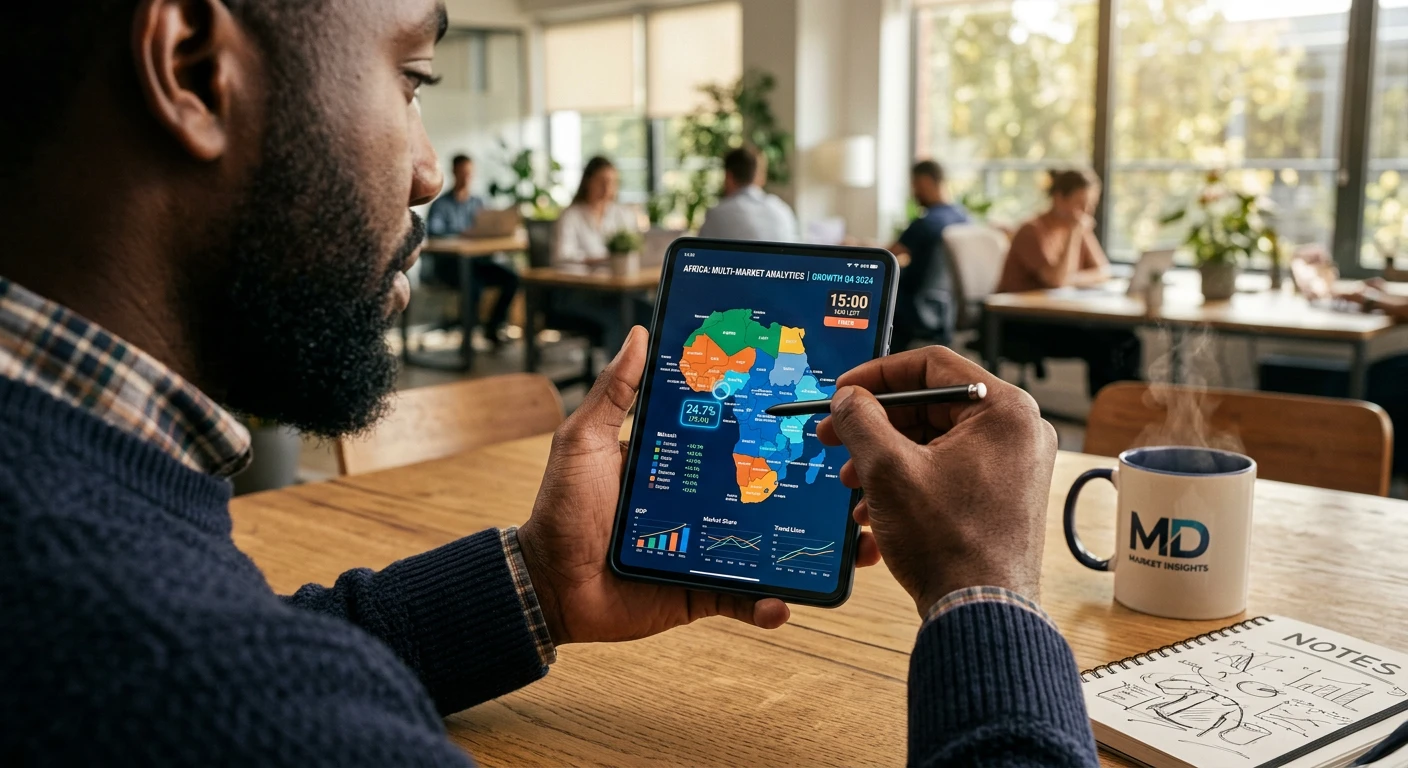
How a Regional Manager Tracks 3 African Markets in 20 Minutes
TidalBet is West Africa's fastest-growing mobile sportsbook, headquartered in Lagos and operating across Nigeria, Ghana, and Kenya. The platform carries roughly forty-five thousand monthly active users, settles in both NGN and USDT, and generates approximately $1.5M per week in gross gaming revenue — eighty-five percent of it from sports, with football and basketball dominating the betting slate. The product is deliberately mobile-first, with USSD integration that brings the sportsbook to players on feature phones where app stores are irrelevant.
Products used: Multi-Market Analytics, Competitive Intelligence, Regulatory Monitor
20 minutes | weekly cross-market review time
3 markets compared | Nigeria, Ghana, Kenya side-by-side in a single session
2.3x | Ghana's weekly growth rate relative to Nigeria, signalling the expansion opportunity
Challenge
Adebayo Ogundimu manages three markets from a single desk in Lagos, but the three markets behave like three different businesses. Nigeria is the anchor — mature, high-volume, increasingly competitive. Ghana is newer and smaller but has been growing faster than anyone internally expected. Kenya is the wildcard, with a different regulatory posture, different payment rails, and a player base that runs almost entirely on M-Pesa rather than bank transfers or crypto.
Every Monday, Adebayo is expected to arrive at TidalBet's weekly regional leadership call with a clear read on each market: what grew, what softened, what the competition is doing, and where the budget should move. Before Gaming Mind AI, assembling that picture took most of Sunday night. He kept three separate spreadsheets — one per market — pulling raw exports from the platform's backend, cross-referencing with a manually maintained competitive tracker his team updated every Thursday, and scanning regulatory news feeds from three different national gambling authority websites. By the time he arrived at Monday's call, the data was already two days stale and the analysis was one spreadsheet formula away from a mistake.
"I was the bottleneck. Three markets, three data sources, zero standardisation between them. I was spending four hours every week building the same picture from scratch, and then another hour in the call explaining what the numbers meant. The business was moving faster than I could track it."
— Adebayo Ogundimu, Regional Manager, TidalBet
The deeper problem was opportunity cost. While Adebayo was reconciling spreadsheets, Ghana was posting growth numbers that deserved real analytical attention — not just a row in a summary table. A competitor had been quietly gaining share in Accra for six weeks before anyone at TidalBet noticed, and by the time the signal surfaced it had already become a problem that required an emergency retention campaign rather than an early, cheaper response.
Solution
Adebayo now opens Gaming Mind AI on Monday morning with a single agenda: one conversation, three markets, twenty minutes. The AI holds all three markets in the same data model and can move between them without switching contexts, which means Adebayo can ask the question he actually wants to ask instead of navigating to the right dashboard first.
Here's what his Monday morning session looks like:
Adebayo: "Give me the weekly numbers for all three markets. GGR, active players, FTDs."
| Market | Weekly GGR | Active Players | FTDs | WoW GGR Change | 4-Week Trend |
|---|---|---|---|---|---|
| Nigeria | $1.02M | 28,400 | 890 | −3.4% | Flat/declining |
| Ghana | $340K | 10,800 | 380 | +9.1% | 🟢 +38% vs 4-week avg |
| Kenya | $138K | 5,800 | 190 | +1.8% | Flat |
| Total | $1.50M | 45,000 | 1,460 | +0.9% | — |
⚠️ Gaming Mind flags: Ghana's 4-week growth rate is running 2.3 times faster than Nigeria's on a normalised basis — the most significant signal in this week's data. Nigeria's 3.4% decline warrants a competition vs. product diagnostic before any budget is moved.
The opening view puts all three markets in parallel rather than in sequence. Nigeria posted $1.02M in GGR — down 3.4% week-over-week on 28,400 active players, with FTDs running at 890. Ghana came in at $340K GGR on 10,800 active players, up 9.1% on the week and up 38% over the trailing four-week average. Kenya held steady at $138K GGR with modest 1.8% growth. Gaming Mind flags Ghana's four-week trend immediately as the most significant signal in the data, noting that the growth rate is running 2.3 times faster than Nigeria's on a normalised basis. Adebayo already suspected Ghana was accelerating. Now he has the number that quantifies it.
Adebayo: "Why is Nigeria down 3.4%? Is this a competition problem or a product problem?"
| Indicator | Data | Assessment |
|---|---|---|
| TidalBet Nigeria existing player retention | 68% — flat | 🟢 Product is not the problem |
| TidalBet Nigeria new player FTDs | −4.2% in Lagos & Rivers State | 🔴 Acquisition problem, geographically specific |
| BetKing welcome bonus campaign launch | 12 days ago | Correlated with FTD drop |
| Sportybet active player gains (same week) | Estimated positive | 🔴 Competitive response needed |
| Geographic concentration of drop | Lagos + Rivers State only | Actionable — not a national problem |
⚠️ Gaming Mind flags: Nigeria's decline is an acquisition and competitive response problem, not a product problem — concentrated in two states and traceable to one BetKing campaign. A targeted reactivation offer for Lagos and Rivers State players is the right response, not a broad national push.
Gaming Mind pulls from Competitive Intelligence to answer this question. The data shows that two competitors — Sportybet and BetKing — both posted estimated active player gains in the same week Nigeria dropped. The timing isn't random: a BetKing welcome bonus campaign launched twelve days ago is correlated with a 4.2% reduction in TidalBet's new player FTDs in Lagos and Rivers State specifically. Existing player retention held flat at 68%, which rules out a product problem. This is an acquisition and competitive response problem, concentrated in two states and traceable to one campaign. Adebayo marks this for the marketing team and moves on.
Adebayo: "Show me Ghana's growth breakdown. Is this organic or is someone buying it?"
| Channel | FTD Share | D30 Retention | Notes |
|---|---|---|---|
| Organic + referral | 61% | 41% | Well above cross-market avg of 34% |
| Affiliate network | 28% | 22% | Predictably lower retention |
| Social / other | 11% | ~30% | — |
| Referral share specifically | 28% | — | 🟢 2x Nigeria's 14% — community signal or stronger incentive |
⚠️ Gaming Mind flags: Ghanaian players are bringing in friends at twice the rate of Nigerian players. This referral-driven organic growth is compounding, not being bought — it is structurally more valuable than affiliate-driven volume.
Ghana's growth is cleaner than the raw numbers suggest. Organic and referral channels account for 61% of FTDs, and D30 retention on those players is running at 41% — well above TidalBet's cross-market average of 34%. The affiliate network is adding volume but with predictably lower retention at 22%. Gaming Mind flags that the referral share in Ghana is unusually high — 28% versus 14% in Nigeria — and identifies it as a structural signal: Ghanaian players are bringing in friends at twice the rate of Nigerian players, which implies either a stronger community fit, a more effective referral incentive, or both. The organic growth isn't being bought. It's compounding.
Adebayo: "What's the product mix difference between Ghana and Nigeria? Same sports, same bets?"
| Product Metric | Nigeria | Ghana | Notes |
|---|---|---|---|
| Accumulator bet share | 54% | 38% | Nigeria accumulator-heavy |
| Single-match bet share | 46% | 62% | Ghana more single-match |
| Avg bet size | NGN 1,850 (~$1.20) | ~$1.75 equivalent | Ghana bettors stake more per bet |
| Virtual sports % of total volume | 7% | 18% | Ghana: 5-minute virtual football popular between live fixtures |
| Basketball penetration | — | +11 pp vs Nigeria | Consistent with NBA viewership in Greater Accra |
⚠️ Gaming Mind flags: Ghana's product preference profile diverges sharply from Nigeria — higher stakes, more single-match bets, heavy virtual sports between live fixtures, and stronger basketball penetration. The Ghana product roadmap should not be a copy of Nigeria's.
This is where the two markets diverge most sharply. Nigeria skews heavily toward accumulator bets — 54% of all sports wagers — and average bet size is NGN 1,850, which at current rates lands just above $1.20. Ghana's players are placing more single-match bets, with only 38% accumulators, and average bet size is $1.75 equivalent in cedis. Virtual sports account for 18% of Ghana's total bet volume versus 7% in Nigeria, driven almost entirely by a virtual football product that runs in five-minute intervals — an important signal about the Ghana player's willingness to engage between live fixtures. Basketball penetration in Ghana is also eleven percentage points higher than Nigeria, which Gaming Mind notes is consistent with NBA viewership data for the Greater Accra region. Adebayo adds this to his notes: the Ghana product roadmap should not be a copy of Nigeria's.
Adebayo: "Any competitive movement in Ghana I should know about? Who's gaining share there?"
| Competitor | Activity in Ghana (Last 30 Days) | Threat Level | Notes |
|---|---|---|---|
| Sportybet | No meaningful acquisition campaign | 🟢 Low current | — |
| BetKing | No meaningful acquisition campaign | 🟢 Low current | Focus is Nigeria |
| BetMomo (regional) | 🔴 Social media spend increasing — 3 consecutive weeks | 🟡 Medium — emerging | Targeting mobile USSD segment; product launch estimated 4–8 weeks out |
⚠️ Gaming Mind flags: BetMomo's social spend trajectory suggests a product launch in 4–8 weeks targeting TidalBet's core USSD acquisition channel in Ghana. A pre-emptive loyalty push to cement the current base before the competitive window narrows is the recommended response.
Competitive Intelligence shows a clean picture in Ghana — for now. Neither Sportybet nor BetKing has launched a meaningful acquisition campaign in Ghana in the last thirty days, which partially explains TidalBet's unchallenged growth rate. Gaming Mind flags one emerging risk: a regional operator called BetMomo has been increasing its social media spend in Accra for three consecutive weeks, with a campaign specifically targeting the mobile USSD segment — TidalBet's core acquisition channel in Ghana. BetMomo's offering is not yet at feature parity, but the social spend trajectory suggests a product launch in the next four to eight weeks. Gaming Mind rates this as a medium-priority threat and recommends a pre-emptive loyalty push to cement the current base before the competitive window narrows.
Adebayo: "What's the Kenya situation? It's been flat for three weeks."
| Metric | Kenya This Week | Notes |
|---|---|---|
| Weekly GGR | $138K | Flat — 3rd consecutive week |
| Active Players | 5,800 | Stable |
| New BCLA Directive | KYC required for >KES 5,000/week wagers | Covers ~22% of active player base |
| Deposit completion rate (affected segment) | 48% completed KYC | 61% started, 13% abandoned |
| GGR volume lost from 13% abandonment | ~$18K/week recovery potential | If rerouted with simplified re-verification + deposit-match incentive |
| M-Pesa deposit volume | Stable | Non-affected players behaving normally |
⚠️ Gaming Mind flags: Kenya's flatness is explained — 13% of the players who started enhanced KYC abandoned without completing it, and that group is the lost volume. A targeted re-engagement push with a simplified re-verification link and deposit-match incentive is projected to recover approximately $18K in weekly GGR.
Kenya's flatness is explained by two forces arriving at the same time. The Regulatory Monitor shows that Kenya's Betting Control and Licensing Board issued a new directive two weeks ago requiring enhanced KYC verification for accounts wagering above KES 5,000 per week — a threshold that captures roughly 22% of TidalBet Kenya's active player base. Deposit completions in that segment dropped 17% in the first week as players encountered the additional verification step. Gaming Mind pulls the completion funnel: 61% of flagged players started the enhanced KYC process, 48% completed it, 13% abandoned. The 13% abandonment is the lost volume. Gaming Mind recommends a targeted re-engagement push to the 13% with a simplified re-verification flow and a deposit-match incentive, projected to recover approximately $18K in weekly GGR if conversion rates hold.
Adebayo: "Based on all of this — where should we put the incremental budget this quarter?"
| Market | Budget Allocation | Objective | Projected GGR Uplift (6 weeks) |
|---|---|---|---|
| Ghana | $85K | Accelerate acquisition ahead of BetMomo launch window | $145K–$200K |
| Nigeria | $40K | Retention — Lagos/Rivers State, counter BetKing welcome bonus | $90K–$130K |
| Kenya | $22K | Re-engage KYC-abandoned segment (13% who dropped off) | $75K–$90K |
| Total | $147K | — | $310K–$420K |
⚠️ Gaming Mind flags: The $147K incremental ask models $310K–$420K in expected GGR uplift over six weeks across all three markets. Ghana gets the largest allocation because the competitive window is narrowing — BetMomo's estimated launch is 4–8 weeks out.
Gaming Mind synthesises the session into a structured budget recommendation. The data supports three parallel moves: a Ghana expansion push of $85K to accelerate acquisition ahead of the BetMomo threat, capitalising on the current competitive window; a Nigeria retention campaign of $40K targeting Lagos and Rivers State directly to counter BetKing's welcome bonus with a reactivation offer for players who reduced wager frequency in the past two weeks; and a Kenya re-engagement allocation of $22K to recover the KYC-abandoned segment. Total incremental ask is $147K, and Gaming Mind models expected GGR uplift at $310K to $420K over the next six weeks across all three markets. Adebayo has the headline numbers, the rationale, and a model he can take into the budget conversation with one slide.
Results
Regional review time cut from four hours to twenty minutes
Adebayo's full Monday session — three markets, competitive landscape, regulatory flag, and a budget proposal — ran nineteen minutes. He didn't open a single spreadsheet, export a single data file, or send a single Slack message to his analytics team before the call.
Ghana expansion proposal submitted the same morning
The budget reallocation proposal — $85K for Ghana, $40K for Nigeria retention, $22K for Kenya recovery — was drafted and submitted to TidalBet's VP of Growth before noon on Monday. It was approved by Wednesday. The Ghana campaign launched the following week, two weeks ahead of the estimated BetMomo product entry window.
Nigeria competitive threat contained before it compounded
The BetKing campaign correlation was identified and acted on in the same week it was surfaced. A reactivation offer targeting lapsed Lagos and Rivers State players went live within four days, recovering 34% of the FTD shortfall within the first two weeks. Without Gaming Mind flagging the geographic concentration of the drop, the campaign would have been a broad national push — less targeted, more expensive, and slower.
Kenya KYC abandonment turned into a recovery campaign
The 13% of players who started but didn't complete enhanced KYC verification were identified, segmented, and re-engaged with a deposit-match incentive and a simplified re-verification link. Within three weeks, Kenya's weekly GGR recovered to its pre-directive level, and deposit completion rates in the affected segment improved from 48% to 67%.
Competitive early warning on BetMomo in Ghana
The BetMomo social spend signal arrived four to eight weeks before a formal product launch. TidalBet used that window to deepen the referral programme in Accra and push a loyalty bonus to active Ghana players before the competitive pressure arrived. When BetMomo launched, TidalBet's Ghana retention rate held at 43% versus an industry baseline of 31%.
"Three markets used to mean three separate Monday mornings crammed into one. Now I see all three at once — the growth signals, the competitive threats, the regulatory flags — and I walk into the call with a budget proposal already written. The only reason we caught Ghana when we did is because the data was telling a story I could actually read."
— Adebayo Ogundimu, Regional Manager, TidalBet
Read in another language
Want to see how Gaming Mind AI can help your operation?
Get a Demo