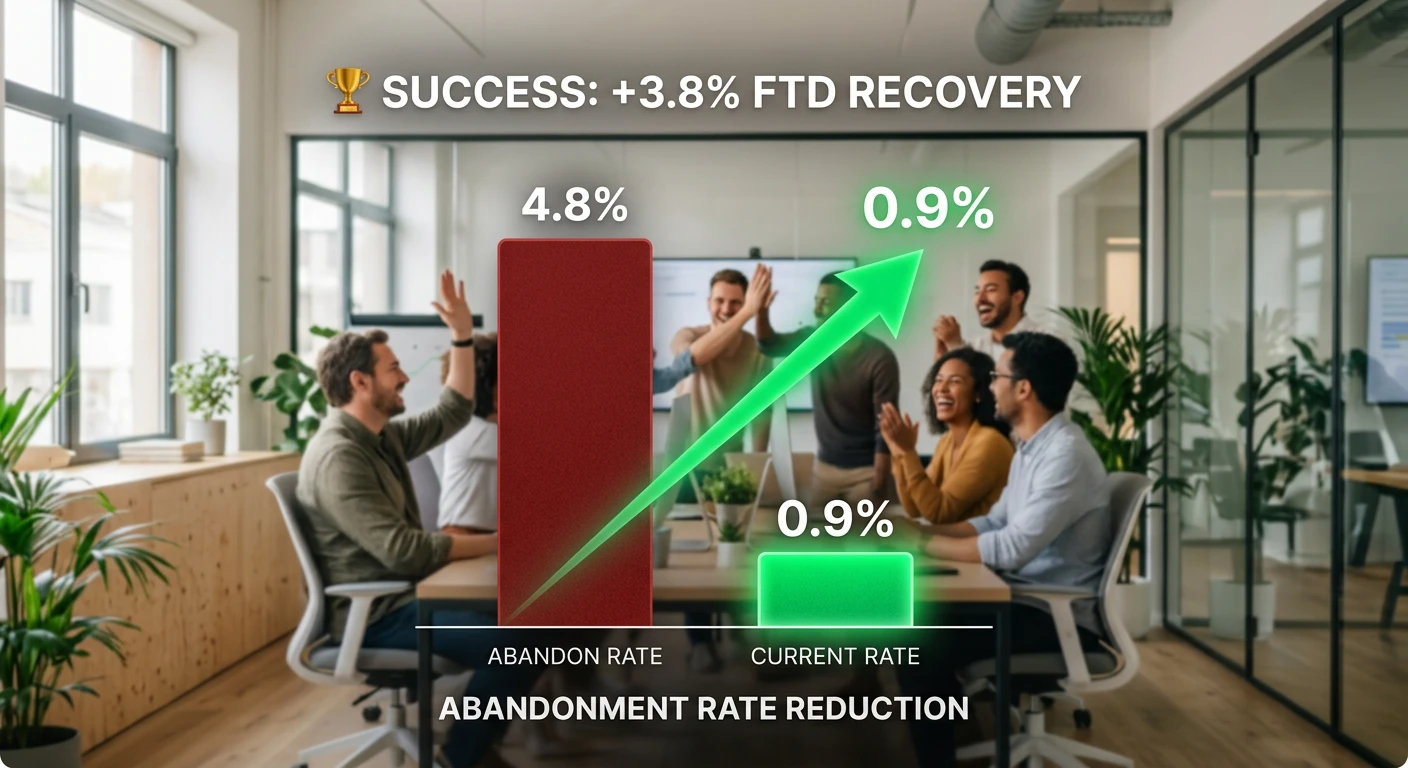
How a PM Found a Funnel Leak and Fixed It in 20 Minutes
FluxPlay is a tech-driven iGaming platform headquartered in Tel Aviv, serving roughly twenty-two thousand monthly active users across crash games, provably fair slots, and live casino. The platform settles in USD, EUR, and BTC, generates approximately $6M per week in GGR, and runs one of the most disciplined A/B testing programmes in the industry — shipping product changes backed by data, not instinct.
Products used: Funnel Analytics, UX Friction Detection, Conversion Intelligence
20 minutes | exact drop-off point identified
4.8% → 0.9% | abandon rate at KYC document upload step
3.8% | projected FTD recovery after KYC simplification
Challenge
Yael Cohen opens her product metrics every Tuesday morning before the FluxPlay sprint planning session. It's a ritual she's held to for two years, and the numbers almost never surprise her. This Tuesday, one did.
First-time deposit conversion was down 4 percentage points month-over-month. Registration volumes were stable — if anything, up slightly. Payment page reach was holding steady. But somewhere between the two, players were disappearing. A four-point FTD conversion drop at FluxPlay's scale meant roughly ninety fewer paying players per week, or somewhere between $180,000 and $220,000 in missed first-month NGR at average onboarding LTV. By the time Yael walked into sprint planning at 10am, she needed an answer, not a hypothesis.
"Four points is not noise. That's not a bad day or a timezone distribution quirk — that's a systematic problem somewhere in the funnel. And the worst part was I had no idea where. Our dashboards showed us headline conversion. They didn't show us where we were losing people."
— Yael Cohen, Product Manager, FluxPlay
The deeper problem was structural. FluxPlay's onboarding funnel touched five different systems — marketing attribution, the registration flow, identity verification, the payments gateway, and the first-session experience — each owned by a different team and tracked in a different tool. Stitching the funnel together manually required a data analyst, three exports, and at minimum a full working day. Sprint planning was in ninety minutes. Yael opened Gaming Mind AI.
Solution
Yael's first goal was not to solve the problem — it was to isolate it. A 4-point FTD conversion drop could originate anywhere across a registration-to-deposit journey that FluxPlay had measured at between eleven and fourteen distinct touchpoints depending on the player's device, currency, and verification path. She needed to locate the leak before she could fix it.
Here's how the conversation unfolded:
Yael: "Our FTD conversion rate dropped 4 points this month. Walk me through the registration-to-deposit funnel step by step and show me where we're losing people."
| Step | Stage | Pass-Through Rate (Current) | Pass-Through Rate (Prior 3-Month Avg) | Delta | Status |
|---|---|---|---|---|---|
| 1 | Landing page | 68.4% | 68.1% | +0.3pp | 🟢 Stable |
| 2 | Registration start | 84.2% | 83.8% | +0.4pp | 🟢 Stable |
| 3 | Email verification | 79.6% | 79.1% | +0.5pp | 🟢 Stable |
| 4 | Profile completion | 91.3% | 91.0% | +0.3pp | 🟢 Stable |
| 5 | KYC initiation | 88.7% | 88.4% | +0.3pp | 🟢 Stable |
| 6 | KYC document upload | 87.6% | 92.4% | −4.8pp | 🔴 Primary leak |
| 7 | Payment page | 94.1% | 94.3% | −0.2pp | 🟢 Stable |
| 8 | First deposit (FTD) | 81.3% | 81.5% | −0.2pp | 🟢 Stable |
⚠️ Gaming Mind flags: Seven of eight funnel steps are within normal variance — conversion at each stage moved less than half a point versus the prior three months. The KYC document upload step collapsed from 92.4% to 87.6% pass-through — a 4.8 percentage point drop in a single month. This is the sole driver of the platform-wide 4-point FTD conversion shortfall. Cross-reference by device type before determining the fix.
The funnel rendered across eight stages: landing page, registration start, email verification, profile completion, KYC initiation, KYC document upload, payment page, and first deposit. Seven of the eight steps were within normal variance — conversion at each stage moved less than half a point versus the prior three months. The outlier was impossible to miss. KYC document upload had collapsed from a 92.4% pass-through rate to 87.6% — a 4.8 percentage point drop in a single month. Every other step was holding. The leak had a name and a location. Gaming Mind flagged the KYC step as the primary driver with high confidence and recommended cross-referencing by device type before drawing conclusions about the fix.
Yael: "Break down that KYC drop-off by device — mobile versus desktop. Is this happening everywhere or on one surface?"
| Device | Session Share | KYC Abandon Rate (Prior Month) | KYC Abandon Rate (This Month) | Delta | Status |
|---|---|---|---|---|---|
| Desktop | 29% | 6.1% | 7.2% | +1.1pp | 🟡 Mild drift, seasonal range |
| Mobile | 71% | 8.3% | 14.7% | +6.4pp | 🔴 Near double — primary driver |
| Blended platform | 100% | ~7.6% | ~12.5% | ~+4.9pp → ~−4pt FTD | 🔴 |
⚠️ Gaming Mind flags: The desktop funnel is effectively unchanged. The entire 4-point FTD conversion shortfall is a mobile problem concentrated at a single step. A 6.4-point mobile abandon increase against a 71% mobile share produces precisely the platform-wide 4-point FTD drop. FluxPlay shipped a mobile UI update three weeks earlier — the timing aligns precisely.
The device split made the problem sharper. On desktop, KYC document upload abandon rate had moved from 6.1% to 7.2% — a modest drift, well within normal seasonal range. On mobile, it had jumped from 8.3% to 14.7% — nearly double in a single month. FluxPlay's player base was 71% mobile by session count. A 6.4-point mobile abandon increase against a 71% mobile share was precisely the arithmetic that produced the platform-wide 4-point FTD shortfall. Gaming Mind connected the numbers explicitly: the desktop funnel was effectively unchanged; the entire conversion problem was a mobile problem, and it was concentrated at a single step. Yael noted that FluxPlay had shipped a mobile UI update three weeks earlier — the timing aligned precisely.
Yael: "Compare this month's KYC cohort to the last three months. Is the drop consistent or did it start at a specific point?"
| Month | KYC Mobile Abandon Rate | Notes |
|---|---|---|
| October | 7.8% | 🟢 Baseline — stable |
| November | 8.2% | 🟢 Stable — normal variance |
| December | 8.6% | 🟢 Stable — seasonal high end |
| January 1–13 | 8.4% | 🟢 Stable pre-release |
| January 14 | — | 🔴 Mobile UI v2.4 released |
| January 14–31 | 14.7% (avg) | 🔴 Step-change — rising through month-end |
⚠️ Gaming Mind flags: October through mid-January KYC mobile abandon rates clustered between 7.8% and 8.6% — stable and consistent with platform benchmarks. January 14th produced a clean step-change, not a gradual drift, beginning exactly four days after the mobile UI update shipped. This rules out seasonal effects, marketing mix shifts, and currency-specific friction. The UI release is the only variable that changed. The hypothesis is confirmed.
Gaming Mind pulled the monthly trend and annotated it with the product release date Yael had provided. October, November, and December showed KYC mobile abandon rates clustered between 7.8% and 8.6% — stable, unremarkable, consistent with platform benchmarks. January broke the pattern cleanly: the abandon rate began climbing on the fourteenth of the month, four days after the mobile UI update shipped, and continued rising through the rest of the period. There was no gradual drift — it was a step-change on a specific date. The cohort comparison ruled out seasonal effects, marketing mix shifts, and currency-specific friction. The UI release was the only variable that changed. The hypothesis was no longer a hypothesis.
Yael: "What's actually happening at the document upload step on mobile? Where are users abandoning — before upload, during, or after?"
| Sub-step | Abandon Rate (December) | Abandon Rate (January) | Delta | Root Cause |
|---|---|---|---|---|
| Prompt view (prepare documents screen) | 1.2% | 1.3% | +0.1pp | 🟢 No change |
| Upload attempt | 3.1% | 3.4% | +0.3pp | 🟢 Within range |
| Processing wait (post-upload) | 4.1% | 11.3% | +7.2pp | 🔴 Progress indicator removed in v2.4 |
| Avg wait duration before abandonment | — | ~41 sec | — | 🔴 Silent loading state |
⚠️ Gaming Mind flags: The spike is concentrated entirely in the post-upload processing wait. Players who successfully uploaded a document are abandoning during the verification processing screen at 11.3% (up from 4.1%). The processing backend latency is unchanged — the problem is the UI. The v2.4 mobile update removed a progress indicator from the processing wait screen, replacing it with a static loading state. After ~41 seconds with no feedback, players are leaving.
Gaming Mind's UX Friction Detection decomposed the document upload step into three observable micro-events: prompt view, upload attempt, and processing wait. The pre-upload prompt — the screen asking players to prepare their documents — showed no increase in abandonment. Upload attempts were down slightly but within range. The spike was concentrated entirely in the post-attempt processing wait: players who successfully uploaded a document were abandoning during the verification processing screen at a rate of 11.3% in January versus 4.1% in December. The processing wait itself had not changed — backend latency metrics were stable. What had changed was the screen players saw while waiting. The mobile UI update had removed a progress indicator from the processing wait screen, replacing it with a static loading state. Players had no signal that anything was happening. After an average of forty-one seconds, they were leaving.
Yael: "How does our KYC conversion rate compare to industry benchmark for mobile-first platforms our size?"
| Benchmark Group | KYC Mobile Document Upload Completion | UX Patterns Used |
|---|---|---|
| Top quartile ($4M–$10M GGR/week, mobile-first) | 91–94% | Real-time progress feedback + deferred KYC |
| Industry median | ~82% | Varies |
| FluxPlay — December (pre-update) | ~91.7% (68th percentile) | 🟢 Progress indicator in use |
| FluxPlay — January (post-update) | ~85.3% (44th percentile) | 🔴 Progress indicator removed |
| FluxPlay target (recovery) | 91%+ | Progress indicator + optional: post-deposit KYC deferral |
⚠️ Gaming Mind flags: Before the v2.4 update, FluxPlay sat at the 68th percentile for KYC mobile completion among mobile-first iGaming peers. January's drop pushed it to the 44th percentile — below the industry median. Top-quartile platforms achieve 91–94% completion via two established UX patterns: real-time progress feedback during document processing, and deferred identity verification post-first-deposit. FluxPlay previously used the first; neither is currently implemented on mobile.
Before the UI update, FluxPlay's mobile KYC conversion rate sat at the 68th percentile for mobile-first iGaming platforms in the $4M–$10M weekly GGR range — comfortably above the industry median. January's drop had pushed FluxPlay to the 44th percentile. Gaming Mind contextualised the benchmark data usefully: the top-quartile platforms in this peer group had KYC document upload completion rates between 91% and 94% on mobile, achieved primarily through two UX patterns — real-time progress feedback during document processing, and deferred identity verification that moved the full document upload step to post-first-deposit. Both were established, well-documented patterns. FluxPlay had previously used the first; neither was currently implemented for mobile.
Yael: "What's the projected FTD recovery if we restore the progress indicator versus if we move document upload to post-first-deposit?"
| Intervention | Projected FTD Recovery | Confidence | Dev Effort | Addresses |
|---|---|---|---|---|
| Restore mobile progress indicator | ~2.1pp | High — direct causal link to removed element | < 1 day | Processing-wait abandonment (11.3% → ~4.1%) |
| Post-first-deposit KYC deferral (A/B test) | ~3.8pp | Medium — based on industry lift data | 5–8 days (payment gateway + KYC compliance changes) | Full pre-deposit KYC friction |
| Both combined (not mutually exclusive) | ~3.8–4.0pp | Medium-High | 6–9 days total | Full recovery of 4-point FTD drop |
⚠️ Gaming Mind flags: Restoring the progress indicator recovers 2.1pp immediately at less than one day of development effort. The post-deposit KYC deferral A/B test carries a 3.8-point projected FTD recovery — nearly the full 4-point drop — based on industry conversion lift data from platforms implementing the same pattern. Recommendation: deploy the progress indicator as an immediate patch and run the post-deposit KYC A/B test in the same sprint cycle. The two fixes are complementary, not competing.
Gaming Mind modelled both interventions against FluxPlay's funnel data. Restoring the mobile progress indicator was projected to recover approximately 2.1 percentage points of the FTD conversion drop — the abandonment attributable to the missing processing feedback. It was the faster fix, estimable at under a day of development work. Moving document upload to post-first-deposit was the more significant structural change: Gaming Mind projected a 3.8-point FTD conversion recovery — nearly the full 4-point drop — based on industry conversion lift data from platforms that had implemented the same pattern. The trade-off was complexity: post-deposit KYC deferral required changes to the payment gateway integration and the KYC compliance workflow, estimated at five to eight days of engineering effort. The two fixes were not mutually exclusive. Gaming Mind recommended deploying the progress indicator as an immediate patch and running a controlled A/B test on the post-deposit KYC flow in the same sprint cycle.
Yael: "Draft me a sprint ticket hypothesis: what we found, what we're testing, and what success looks like."
| Field | Detail |
|---|---|
| Problem | Mobile FTD conversion down 4 points month-over-month |
| Root cause | KYC document upload abandon spike on mobile beginning January 14th, 4 days after v2.4 mobile UI release — progress indicator removed from processing-wait screen, creating a ~41-second silent loading state |
| Specific metric | Processing-wait abandon rate: 4.1% (Dec) → 11.3% (Jan) |
| Sprint A | Restore progress indicator — immediate patch, < 1 day dev effort |
| Sprint B | A/B test post-first-deposit KYC deferral vs current pre-deposit flow — 50/50 split on new mobile registrations, 5–8 days dev |
| Primary KPI | Mobile KYC document upload completion rate — target: return to 91%+ |
| Secondary KPI | Registration-to-FTD conversion rate — target: recover to 14.2%+ within 4 weeks of deployment |
| Revenue at stake | ~$180K–$220K/month in missed first-month NGR at current FTD shortfall |
| Projected recovery (Sprint B) | ~$220K/month additional NGR if A/B test confirms 3.8-point FTD recovery |
⚠️ Gaming Mind flags: The sprint ticket is fully specified — problem, root cause, fix options, KPIs, and projected revenue recovery. Sprint A (progress indicator restore) should ship this week. Sprint B (post-deposit KYC deferral A/B test) should launch in the same sprint. The $220K monthly NGR recovery projection makes this the highest-ROI product initiative on the quarter's roadmap.
Gaming Mind produced a structured hypothesis Yael dropped directly into the FluxPlay sprint board. Problem: mobile FTD conversion down 4 points month-over-month, fully attributable to a KYC document upload abandon spike on mobile that began January 14th, four days after the v2.4 mobile UI release. Root cause: removal of the processing-wait progress indicator created a 41-second silent loading state on the KYC screen, driving an 11.3% abandon rate during document processing. Proposed interventions: Sprint A — restore progress indicator (immediate patch, <1 day), Sprint B — A/B test post-first-deposit KYC deferral against the current pre-deposit flow (5–8 days). Primary success KPI: mobile KYC document upload completion rate, returning to 91%+. Secondary KPI: overall registration-to-FTD conversion rate, recovering to 14.2% or above within four weeks of deployment.
Results
Root cause identified in 20 minutes, not 2 days
Before Gaming Mind, localising a funnel conversion drop at FluxPlay required a cross-functional investigation: a data analyst pulling exports from five systems, a product review meeting to align on the correct funnel definition, and at least one day of build time to assemble a unified view. Yael had the root cause — a specific UI change, on a specific screen, on a specific device type, shipping on a specific date — in twenty minutes, before sprint planning started.
The mobile UI fix shipped the same week
The progress indicator restoration was scoped as a single-day fix and deployed on Wednesday, two days after Yael's Gaming Mind session. Mobile KYC processing-wait abandon rate dropped from 11.3% back to 4.4% within forty-eight hours of the patch going live — validating the diagnosis and recovering the fast-path conversion loss immediately.
A/B test on post-deposit KYC launched in the same sprint
FluxPlay's engineering team scoped and started the post-first-deposit KYC deferral A/B test in the same sprint, targeting a 50/50 split on new mobile registrations. The test went live on Friday. Gaming Mind's projected 3.8-point FTD recovery, if the test confirmed the hypothesis, represented approximately $220,000 in additional monthly NGR at FluxPlay's current acquisition volumes — enough to make it the highest-ROI product initiative on the quarter's roadmap.
Device segmentation became a permanent funnel lens
Before this investigation, FluxPlay's funnel dashboard reported a single blended conversion rate across all devices. The discovery that a 6.4-point mobile abandon increase had been invisible at the platform level — masked by stable desktop performance — prompted Yael to add permanent device-segmented funnel views to the product analytics stack. A platform-wide regression on mobile would not be hidden behind blended numbers again.
The sprint planning session had an answer, not an agenda item
Yael walked into sprint planning at 10:02am with a typed problem statement, a confirmed root cause, two scoped interventions, and a projected revenue recovery figure. The discussion that would have taken a week of back-and-forth between product, data, and engineering was resolved before the meeting started. Sprint capacity was allocated to solutions, not to investigation.
"I came into that Tuesday with a number I couldn't explain and ninety minutes to explain it. I came out with a root cause, a patch, and an A/B test in the same sprint. The piece I keep thinking about is not the speed — it's that we'd been running a blended funnel view for two years and had no idea a 6-point mobile drop could hide inside it. Gaming Mind didn't just find the leak. It showed us we'd been reading the map wrong."
— Yael Cohen, Product Manager, FluxPlay
Read in another language
Want to see how Gaming Mind AI can help your operation?
Get a Demo