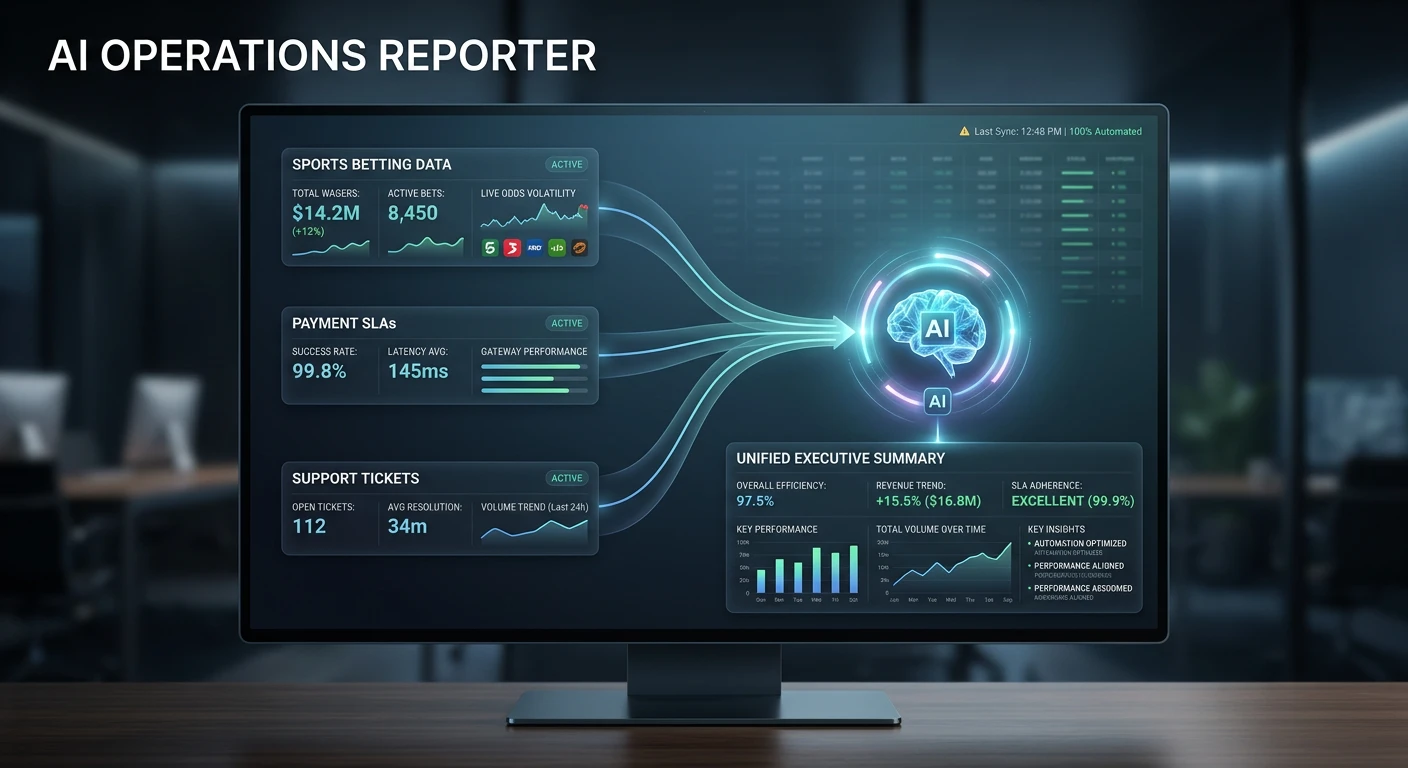
How a Head of Operations Closes the Weekly Ops Report in 20 Minutes
RunWild Gaming is a sports-first iGaming platform headquartered in São Paulo, serving roughly eighteen thousand monthly active players across Brazil and Spanish-speaking LATAM markets. The platform leads with football betting — Brasileirão, Copa Libertadores, and European leagues drive the bulk of wagering volume — with a growing casino vertical rounding out the mix. Revenue settles in a split of BRL and USDT, generating approximately $6M per week in gross gaming revenue.
Products used: AI Operations Reporter, SLA Tracking, Capacity Analytics
20 minutes | full weekly ops report generated
1 report | sent to leadership at 4:22pm, before the 5pm deadline
Full day → 20 min | analyst time saved on weekly ops reporting
Challenge
Every Friday at 4pm, leadership expects a comprehensive weekly operations report on their desks by 5pm. For Sofia Reyes, RunWild's Head of Operations, that one-hour window used to mean skipping lunch and starting the real work at noon.
The report covered everything — week-over-week GGR vs. targets, platform uptime and latency, payment processor SLAs, player satisfaction proxies, support ticket resolution times, the incident log, and a capacity planning outlook for the weekend. None of it lived in the same place. Uptime stats came from the infrastructure team's Slack thread. Payment SLAs came from a spreadsheet the finance team maintained. Support metrics came from the helpdesk tool. GGR targets came from the commercial team's planning doc. Sofia would spend six to seven hours aggregating numbers that each required a different person to confirm, a different format to parse, and a different tool to access.
The deeper problem was accuracy under pressure. When you're copy-pasting numbers across five different sources on a deadline, something always goes wrong. A week in November had a transposition error in the uptime figure that made it to the CEO before anyone caught it. In Brazil's regulatory environment — where the Secretaria de Prêmios e Apostas has sharpened compliance expectations following the 2023 framework — an inaccurate ops report isn't just an embarrassment; it's a liability.
"I used to start building the Friday report on Thursday afternoon. I'd send messages to five different people asking them to confirm their numbers, chase them Friday morning, and still be at my desk at 6pm cleaning up the deck. It wasn't sustainable and it wasn't accurate."
— Sofia Reyes, Head of Operations, RunWild Gaming
The irony was that RunWild had invested heavily in data infrastructure. The data was there. It just wasn't connected in any way that let a non-technical operator like Sofia ask a natural question and get a complete, reliable answer in one place.
Solution
Sofia now opens Gaming Mind AI at 4pm every Friday. The entire weekly ops report — eight sections, executive summary included — is generated in a single conversation. The first draft arrives in her hands before 4:30pm. She reviews it, adds one or two qualitative notes from the week, and sends it at 4:22pm.
Here's what a typical Friday session looks like:
Sofia: "How did we perform against GGR targets this week?"
| Vertical | Target | Actual | Variance | vs. Target | Status |
|---|---|---|---|---|---|
| Football Betting | ~$4.83M | ~$4.74M | −$90K | −1.9% (98.1% of target) | 🟢 |
| Casino Slots | ~$1.07M | ~$0.95M | −$120K | −11.2% | 🔴 |
| Live Casino Tables | ~$0.20M | ~$0.20M | ~flat | On plan | 🟢 |
| Total GGR | $6.10M | $5.89M | −$210K | −3.4% | 🟡 |
⚠️ Gaming Mind flags: The miss is entirely attributable to casino slots, which ran 11.2% below forecast after a progressive jackpot game was pulled from the lobby on Tuesday and Wednesday due to a mechanical issue with a key provider. Two days of lost jackpot visibility cost an estimated R$280K in slot GGR. Football betting was essentially on plan at 98.1% of target. This incident should be logged against the provider SLA.
The headline is immediately clear: RunWild came in at $5.89M GGR against a $6.1M target, a 3.4% miss. Gaming Mind doesn't stop at the gap — it attributes it. Football betting hit 98.1% of target, essentially on plan. The miss came almost entirely from casino slots, which ran 11.2% below forecast after a mechanical issue with a progressive jackpot game at a key provider caused it to be pulled from the lobby on Tuesday and Wednesday. Gaming Mind flags that two days of lost jackpot visibility cost an estimated R$280K in slot GGR and recommends the incident be logged against the provider SLA. Sofia didn't need to call the product team to find out why slots underperformed. The explanation was already there.
Sofia: "Walk me through platform uptime and latency for the week."
| Metric | Value | SLA Target | Status |
|---|---|---|---|
| Core platform availability | 99.94% | 99.9% | 🟢 |
| Sportsbook P95 latency (normal) | ~210ms | <500ms | 🟢 |
| Sportsbook P95 latency (Wed spike peak) | >800ms | <500ms | 🔴 |
| Latency spike duration | 11 minutes | 0 | 🟡 |
| Spike trigger | Flamengo vs. Palmeiras match — 4.1× baseline concurrent users | — | — |
| Official downtime logged | None | — | 🟢 |
⚠️ Gaming Mind flags: The raw 99.94% availability figure is above SLA — but it buries a critical nuance. Two latency spikes on Wednesday evening pushed P95 sportsbook response times above 800ms for 11 minutes during a top fixture, at 4.1× baseline concurrent users. No official downtime was logged, but this is a leading indicator of capacity risk for Sunday's Atletico Mineiro match.
Core platform availability came in at 99.94% for the week — above the 99.9% SLA target — but Gaming Mind surfaces a nuance that the raw number would bury. Two latency spikes on Wednesday evening, during the Flamengo vs. Palmeiras match, pushed P95 response times on the sportsbook front-end above 800ms for eleven minutes. No official downtime was logged, but eleven minutes of degraded performance on a top-fixture evening is the kind of thing operators need to know about. Gaming Mind marks the spikes as a capacity event and links them to the sportsbook traffic surge — 4.1x the baseline concurrent user count at kickoff.
Sofia: "How did payment processors perform? Any SLA breaches?"
| Provider | Type | Success Rate | Contractual Floor | SLA Status | Notes |
|---|---|---|---|---|---|
| PIX (BRL) | Deposits & Withdrawals | 98.7% | 98.0% | 🟢 No breach | Clean across full week |
| Primary Crypto (USDT) | Settlements | 97.2% | 95.0% | 🟢 No breach | All processing time windows met |
| Mid-tier Card Acquirer | Deposits | 93.1% | 95.0% | 🔴 SLA BREACH | 47-min degradation window, Fri morning |
| Estimated missed deposit volume (card) | R$94K | Breach incident documented |
⚠️ Gaming Mind flags: The mid-tier card acquirer logged a deposit success rate of 93.1% during a 47-minute processing degradation window on Friday morning — below its 95% contractual threshold. This is a confirmed SLA breach. Estimated missed deposit volume: R$94K. The incident record — including exact time window, transaction count, and triggered SLA clause — has been drafted automatically.
Three payment providers processed RunWild's volume this week. PIX, which handles the majority of BRL deposits, ran a 98.7% success rate against a 98% contractual floor — clean. The primary crypto processor for USDT settlements delivered a 97.2% success rate and met all processing time windows. The issue was with one mid-tier card acquirer, which logged a deposit success rate of 93.1% on Friday morning — below its 95% contractual threshold — during a 47-minute processing degradation window. Gaming Mind flags this as a breach event, calculates the estimated missed deposit volume at R$94K, and drafts the incident record automatically, including the exact time window, transaction count, and the SLA clause it triggers. That alone would have taken Sofia thirty minutes to document manually.
Sofia: "Give me a player satisfaction proxy — complaints, bonus disputes, anything that signals friction."
| Satisfaction Proxy | This Week | Prior Week | Change | Status |
|---|---|---|---|---|
| Contact rate (% MAU reaching support) | 3.1% | 3.6% | −0.5pp | 🟢 |
| Bonus dispute tickets | Down 18% WoW | — | After Mon terms clarification | 🟢 |
| BRL withdrawal delay complaints (Thu) | 41 tickets | — | UX display bug, not processing | 🟡 |
| PIX actual settlement time | Normal | Normal | No degradation | 🟢 |
| In-app status screen accuracy | Showing "pending" up to 40 min post-settlement | — | UX display bug only | 🟡 |
⚠️ Gaming Mind flags: The 41 Thursday tickets about BRL withdrawal delays are not a processing failure — PIX settlement times were normal. The in-app status screen is showing "pending" for up to 40 minutes after funds have already landed. This is a medium-priority product/UX bug that should be escalated to engineering in the weekly handoff to prevent it from generating ongoing unnecessary player contacts.
Gaming Mind draws on support ticket categories and in-product signals rather than surveys, which RunWild doesn't run. Contact rate — the percentage of active players who reached support at least once — came in at 3.1%, down from 3.6% the prior week. Bonus dispute tickets dropped 18% week-over-week after a promotional terms clarification rolled out on Monday. The one area of friction: a cluster of 41 tickets on Thursday afternoon related to BRL withdrawal delay messaging. Players weren't experiencing longer waits — PIX settlement times were normal — but the in-app status screen wasn't updating in real-time and showed "pending" for up to forty minutes after funds had already landed. A UX display bug, not a processing failure. Gaming Mind surfaces it as a medium-priority product issue for the weekly handoff to engineering.
Sofia: "How fast are we resolving support tickets? Any backlog building?"
| Metric | This Week | Prior Week | Target | Status |
|---|---|---|---|---|
| Median first response time | 3.8 min | 3.5 min | <5 min | 🟢 |
| Median resolution time | 22 min | 19 min | <30 min | 🟢 |
| Open tickets >48 hours old | 34 | ~18 (est.) | 0 | 🔴 |
| KYC document review backlog | Part of 34 | — | Process bottleneck | 🟡 |
| Bonus crediting edge case backlog | Part of 34 | — | Requires manual intervention | 🟡 |
⚠️ Gaming Mind flags: The 34 tickets older than 48 hours are not a volume problem — they are process bottlenecks concentrated in KYC document review and a specific bonus crediting edge case requiring manual intervention. The KYC backlog should be flagged to the compliance team before the weekend: Friday-to-Sunday is historically RunWild's highest registration volume window, and delays translate directly to frustrated first-time depositors.
Median first response time held at 3.8 minutes, inside the 5-minute target. Median resolution time for the week was 22 minutes — up slightly from 19 minutes the prior week, but within acceptable range. What Gaming Mind surfaces beyond the averages is more useful: there are 34 tickets in the open queue that are older than 48 hours, concentrated in two categories — KYC document review requests and a specific bonus crediting edge case that requires manual intervention. These aren't volume problems; they're process bottlenecks. Gaming Mind recommends flagging the KYC backlog to the compliance team before the weekend, as Friday-to-Sunday is historically RunWild's highest registration volume window and delays there translate directly to frustrated first-time depositors.
Sofia: "Pull together this week's incident log for the report."
| # | Incident | Severity | Duration | Root Cause | SLA Impact |
|---|---|---|---|---|---|
| 1 | Progressive jackpot game pulled from lobby (Tue–Wed) | P2 | 48 hours | Provider mechanical issue | Commercial impact — R$280K slot GGR loss; SLA claim recommended |
| 2 | Sportsbook latency spikes — Flamengo match (Wed evening) | P3 | 11 minutes | Capacity: 4.1× baseline concurrent users | No formal SLA breach; capacity risk flagged |
| 3 | Card acquirer deposit processing degradation (Fri morning) | P2 | 47 minutes | Provider-side processing degradation | 🔴 SLA breach confirmed — R$94K missed deposits |
| 4 | BRL withdrawal display bug — "pending" status lag | P3 | Ongoing | UX display only; no actual processing impact | No SLA impact; escalated to engineering |
⚠️ Gaming Mind flags: Two of the four incidents this week are P2 severity with direct revenue or SLA implications. The card acquirer breach is fully documented and ready for the vendor review call. The progressive jackpot outage should be logged against the provider SLA — two days of lost jackpot lobby visibility cost an estimated R$280K.
Gaming Mind compiles four incidents from the week into a structured log: the progressive jackpot provider pull-down (P2 severity, commercial impact, 48-hour duration), the Wednesday latency spikes during the Flamengo match (P3, no SLA breach, capacity-related), the card acquirer processing degradation Friday morning (P2, SLA breach confirmed, 47 minutes), and the BRL withdrawal display bug (P3, UX-only, no actual processing impact). Each incident is logged with time stamps, resolution time, root cause classification, and SLA impact status. The format matches exactly what leadership expects in the report, and Sofia doesn't have to reconstruct it from memory, Slack, or email threads.
Sofia: "Do we have enough headroom for this weekend? Atletico Mineiro plays Sunday and it'll be a big traffic night."
| Capacity Metric | Value | Status |
|---|---|---|
| Atletico Mineiro match historical traffic range | 3.8×–4.6× baseline | — |
| Previous record peak (2024 quarter-final) | 4.4× baseline | — |
| Current infrastructure ceiling (before auto-scaling) | 4.2× baseline | 🟡 |
| Wednesday latency event trigger level | 4.1× baseline | 🔴 Reference event |
| Sunday risk rating | Moderate | 🟡 |
| Recommended action 1 | Pre-spin reserve sportsbook cache layer 2 hrs before kickoff | ~10 min to action |
| Recommended action 2 | Pre-warm PIX settlement queues ahead of post-match withdrawal surge | ~10 min to action |
⚠️ Gaming Mind flags: Sunday's Atletico Mineiro Copa Libertadores match is projected to push concurrent users to 3.8×–4.6× baseline — and the Wednesday latency event already proved that 4.1× strains current headroom. With the infrastructure ceiling at 4.2× before auto-scaling, Sunday is a moderate risk event. Both mitigation actions take under 10 minutes each and can be delegated immediately.
Gaming Mind models the Sunday projection against RunWild's historical traffic data for comparable fixtures. Atletico Mineiro Copa Libertadores matches have driven between 3.8x and 4.6x baseline concurrent users at kickoff, with the previous record being 4.4x during the 2024 quarter-final. Current infrastructure headroom supports up to 4.2x before auto-scaling kicks in. Given the Wednesday latency event at 4.1x, Gaming Mind rates the Sunday risk as moderate and recommends two actions: proactively spinning up the reserve sportsbook cache layer two hours before kickoff, and alerting the payments team to pre-warm the PIX settlement queues ahead of the expected post-match withdrawal surge. Both actions take less than ten minutes to action and can be delegated immediately.
Sofia: "Give me the executive summary for the full report."
| Section | Finding | Action Required |
|---|---|---|
| GGR | $5.89M vs. $6.1M target (−3.4%); miss entirely due to provider slot disruption Tue–Wed | Log R$280K slot loss against provider SLA |
| Platform Availability | 99.94% — above 99.9% SLA target; but Wed latency spikes at 4.1× load | Pre-spin sportsbook cache 2 hrs before Sunday kickoff |
| Payment SLAs | PIX + primary crypto clean; mid-tier card acquirer breached 95% floor for 47 min on Fri | Send SLA breach documentation to vendor; review call Monday |
| Player Satisfaction | Contact rate improved (3.1% vs. 3.6%); bonus disputes −18%; BRL display bug generating false anxiety tickets | Escalate UX display bug to engineering today |
| Weekend Outlook | Moderate capacity risk for Sunday Atletico Mineiro match (3.8×–4.6× baseline expected) | Pre-warm PIX settlement queues before kickoff |
| KYC Backlog | 34 tickets >48 hours; KYC cluster risks first-deposit friction over registration-heavy weekend | Flag to compliance team before end of day |
⚠️ Gaming Mind flags: Three actions are recommended before market close today: (1) escalate the KYC backlog to compliance ahead of the high-registration weekend window; (2) pre-spin the sportsbook cache layer for Sunday's Atletico Mineiro match; (3) notify engineering on the BRL withdrawal display bug. Football betting was on plan — the GGR miss was entirely provider-driven and documentable.
Gaming Mind produces a structured executive summary Sofia pastes directly into the report template. GGR came in at $5.89M against a $6.1M target, with the 3.4% miss attributable entirely to two days of provider-driven slot disruption — football betting was on plan. Platform availability met SLA at 99.94%, though a capacity-related latency event during Wednesday's prime fixture warrants a pre-emptive action ahead of Sunday's Atletico Mineiro match. One payment provider breached its deposit success rate SLA for 47 minutes on Friday morning; incident documentation has been prepared. Player satisfaction signals improved week-over-week. Three action items are recommended before market close today: escalate the KYC backlog to compliance, pre-spin the sportsbook cache layer for Sunday, and notify the engineering team on the BRL withdrawal display bug.
Results
A full-day report now takes twenty minutes
The weekly ops report that previously consumed six to seven hours of Sofia's Thursday and Friday — including chasing five separate teams for data confirmations — now takes a single twenty-minute Gaming Mind session. Sofia sent the complete, polished report at 4:22pm without opening a spreadsheet or sending a single "can you confirm the number?" Slack message.
SLA breach documentation was created automatically
The card acquirer SLA breach on Friday morning was fully documented — time window, transaction count, estimated revenue impact, contractual clause — without Sofia spending thirty minutes reconstructing it manually. That documentation was in the report and ready for the vendor review call the following Monday.
A capacity risk was flagged before the weekend window
The Wednesday latency event and its connection to the Sunday Atletico Mineiro fixture was surfaced proactively. Sofia delegated both recommended actions to the infrastructure team by 4:45pm Friday. The match ran without incident — no latency spikes, no escalations — with peak concurrent users reaching 4.3x baseline.
A product bug was caught in the weekly cycle rather than the monthly review
The BRL withdrawal display bug — a UX issue creating false anxiety for players with successful transactions — was identified through support ticket clustering and escalated to engineering within the same Friday session. Without the ops report surfacing it, it would have sat in the support queue until the next monthly product review, accumulating unnecessary player contacts in the interim.
"I used to dread Friday afternoons. Now I almost look forward to them. I open Gaming Mind at 4pm, I have the full picture by 4:25pm, and I'm sending the report by 4:30pm. The quality is better than what I was producing in a full day, because the AI actually catches the connections between things — the Wednesday latency issue and Sunday's fixture, the slot miss and the provider SLA. I was too buried in tabs to see those connections before."
— Sofia Reyes, Head of Operations, RunWild Gaming
Read in another language
Want to see how Gaming Mind AI can help your operation?
Get a Demo