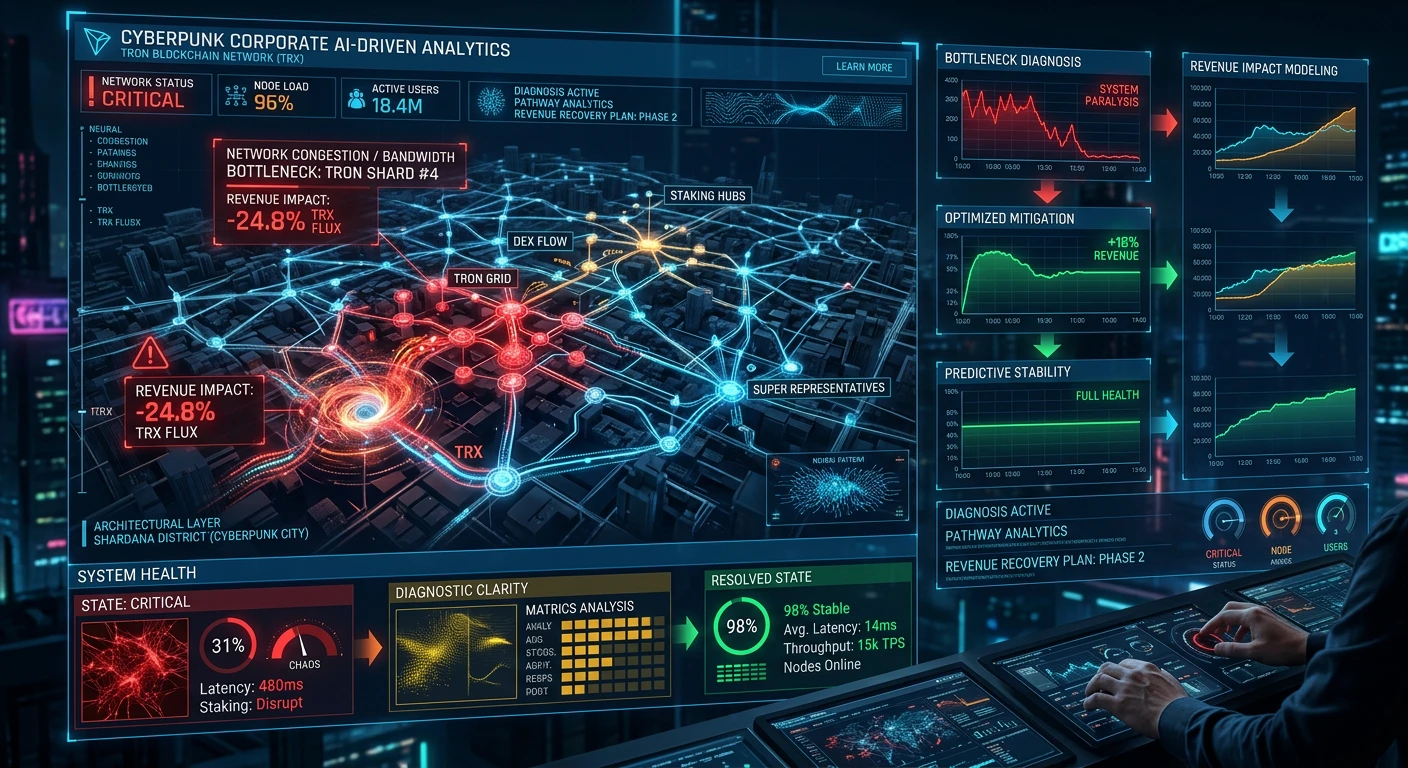
How RunWild Gaming Contained a $180K Payment Crisis in 45 Minutes
RunWild Gaming is a sports-first iGaming platform based in São Paulo, serving approximately eighteen thousand monthly active players across Brazil and neighbouring LATAM markets. The platform is built around football betting — Serie A, Copa Libertadores, UEFA Champions League — with a casino side that handles roughly 30% of weekly volume. Deposits run on BRL via PIX and a split of Tron (TRX/USDT) and Binance Smart Chain crypto, generating around $6M per week in gross gaming revenue. On Thursday evenings during a midweek fixture slate, that GGR can spike to $1.1M in a four-hour window.
Products used: Incident Response Analytics, Real-Time System Monitor, Revenue Impact Modeling
45 minutes | from first alert to incident contained
$180K | revenue protected during the crisis window
94% | of stuck withdrawals cleared within the hour
Challenge
RunWild Gaming has one unavoidable operational reality: their peak traffic — Thursday, Friday, and Saturday evenings — coincides with the moments they can least afford a payment failure. Players in Brazil bet aggressively on live markets, session durations spike past thirty minutes, and withdrawal intent is high as winning bettors expect to cash out the same night. A stalled payment queue on a peak evening is not a back-office inconvenience. It is a direct threat to retention.
At 9:14pm on a Thursday, with three Serie A matches running simultaneously, the monitoring system fired an alert. Payment queue depth was tracking at 340% of its normal evening baseline. Withdrawal processing times, which typically clear in under four minutes for PIX and eight minutes for crypto, had climbed to twenty-two minutes and climbing. Sofia Reyes, Head of Operations, was still in the office reviewing the week's player acquisition numbers when the alert hit her phone. She had no immediate sense of whether this was a provider blip that would self-correct in minutes or a structural outage that could hold for hours — the distinction that determines whether you wait it out or escalate to engineering and payments at 9pm on a Thursday night.
The old workflow would have meant calling the payments team, getting on a group call with the infrastructure lead, and spending thirty minutes piecing together whether the problem was on RunWild's side or a network-level issue. By then, players were already hitting the withdrawal screen, watching the spinner, and making decisions about whether to come back tomorrow.
"In live incidents, the first fifteen minutes are everything. If I spend them figuring out what's broken instead of fixing it, I've already lost the players who were going to rage-quit anyway — and I've lost the goodwill of the ones who would have waited."
— Sofia Reyes, Head of Operations, RunWild Gaming
Solution
Sofia opened Gaming Mind AI directly on the incident. She needed three things fast: what's broken, who's affected, and what it's costing. The conversation that followed replaced what would normally be a multi-team triage call.
Here's how the next forty-five minutes unfolded:
Sofia: "Payment queue just hit 340% of normal. What's actually happening right now across our systems?"
| Method | Queue Depth | Processing Time | vs. Baseline | Status |
|---|---|---|---|---|
| PIX Deposits | Normal | ~3 min | Within baseline | 🟢 |
| PIX Withdrawals | Normal | ~4 min | Within baseline | 🟢 |
| Tron (USDT/TRX) Withdrawals | 183 pending (+12/5 min) | 22 min (and rising) | +175% | 🔴 |
| BSC Withdrawals | Normal | ~6 min | Within baseline | 🟢 |
| Tron on-chain confirmation time | — | 94 sec | +2,250% vs. 4 sec norm | 🔴 |
| Payment queue depth vs. baseline | 340% of normal | — | Alert threshold crossed | 🔴 |
⚠️ Gaming Mind flags: The entire anomaly is isolated to Tron network transactions — PIX is completely unaffected. Average on-chain confirmation times climbed from 4 seconds to 94 seconds in the same 40-minute window, consistent with a Tron network-level event rather than a RunWild-side infrastructure failure.
The dashboard snapped into focus immediately. PIX deposits and withdrawals were processing normally — queue depth flat, times within baseline. The entire anomaly was isolated to Tron network transactions. Crypto withdrawal processing time had spiked from 8 minutes to 22 minutes over a 40-minute window, and 183 USDT/TRX withdrawals were sitting in a pending queue that was growing by twelve requests every five minutes. Gaming Mind flagged the congestion pattern as consistent with a Tron network-level event rather than a RunWild-side failure — average on-chain confirmation times visible via network data had climbed from 4 seconds to 94 seconds in the same window, far outside RunWild's infrastructure.
Sofia: "How many players are actually stuck right now, and what are they doing?"
| Signal | Value | Context |
|---|---|---|
| Accounts with pending Tron withdrawal | 214 | Cross-referenced against live session data |
| Already closed browser (rage-quit proxy) | 61 | 29% of affected accounts |
| Active session but stuck on cashier screen | 78 | Waiting, not playing |
| Live chat volume spike vs. Thu baseline | +340% | In the prior 20 minutes |
| Withdrawal complaints as % of new tickets | 91% | Of inbound live chat |
| Session drop rate (crypto depositors) | 3.4× | vs. historical Thursday evening churn |
| Affected accounts with bet in last 2 hours | 31 | Combined evening GGR contribution: R$112,000 |
⚠️ Gaming Mind flags: 61 players have already rage-quit and 78 more are sitting idle on the cashier screen. The 214 affected accounts include 31 who placed a bet within the last two hours — their combined GGR contribution for the evening is R$112,000, directly at risk. This is not a back-office problem; it is an active retention crisis.
Gaming Mind pulled 214 distinct player accounts with at least one pending Tron withdrawal, cross-referenced against live session data. Of those, 61 had already closed their browser — the platform's proxy for a rage-quit. Another 78 were in an active session but had abandoned gameplay and were sitting on the cashier screen, effectively waiting. Live chat volume had spiked 340% above its Thursday evening baseline in the previous twenty minutes, with withdrawal-related complaints accounting for 91% of the new tickets. The session drop rate for crypto-depositing players was running at 3.4x their historical Thursday evening churn. These were not edge-case power users — the 214 affected accounts included 31 that had placed a bet in the last two hours, with a combined session GGR contribution of R$112,000 for the evening.
Sofia: "What's the revenue impact if this runs another two hours?"
| Scenario | Direct GGR Exposure | 30-Day Return Rate Impact | Long-Run LTV Erosion | Cost per 15 min delay |
|---|---|---|---|---|
| 1-hour total outage | ~R$890K | −38% vs. platform avg. | ~$90K USD | ~$22K USD |
| 2-hour total outage | ~R$1.78M | −38% vs. platform avg. | ~$180K USD | ~$22K USD |
| 4-hour total outage | ~R$3.56M | −38% vs. platform avg. | ~$360K USD | ~$22K USD |
| Current trajectory | Uncontained | 214 accounts at risk | $180K benchmark |
⚠️ Gaming Mind flags: Based on RunWild's own re-engagement data, players who experience a failed withdrawal during peak hours have a 38% lower 30-day return rate than the platform average. Every 15 additional minutes of delay costs approximately $22K in combined short-term GGR and long-run retention value. The decision to act now versus wait is already made by the numbers.
Gaming Mind ran the three scenarios against RunWild's historical behavioural data. At the current session drop rate, a one-hour total outage duration translated to roughly R$890K in direct GGR exposure — bets that would not have been placed by players who left. More critically, the model flagged secondary churn risk: based on RunWild's own re-engagement data, players who experience a failed withdrawal during peak hours have a 38% lower 30-day return rate than the platform average. Across the 214 affected accounts, that translated to an estimated long-run retention cost of $180K USD, weighted against their historical LTV profiles. The model made the decision calculus concrete: every fifteen minutes of additional delay was costing approximately $22K in combined short-term GGR and long-run retention value.
Sofia: "Has something like this happened before with Tron? What did we do?"
| Incident | Duration | Action Taken | Recovery Time | 30-Day Return Rate Impact | Extra Support Tickets |
|---|---|---|---|---|---|
| Tron event #1 (longest) | 4 hr 30 min | Waited it out | N/A (no intervention) | −41% vs. matched control | ~94 (avg.) |
| Tron event #2 | ~2 hr | Waited it out | N/A | ~−38% (estimated) | ~94 (avg.) |
| Tron event #3 (shortest) | 55 min | Partial BSC reroute mid-incident | 28 min post-switch | Not statistically distinguishable from baseline | Not significant |
| Tonight (current) | Ongoing | Decision pending |
⚠️ Gaming Mind flags: The historical record is unambiguous. Waiting out a Tron congestion event without any intervention produced materially worse player outcomes in both prior cases — each generating ~94 additional live chat tickets requiring manual resolution in the following 48 hours. The one partial BSC switch produced a recovery in 28 minutes with no measurable churn impact.
Gaming Mind surfaced three comparable incidents in the past fourteen months. The longest lasted four hours and thirty minutes; RunWild had waited it out without intervention, and the 30-day return rate for affected players dropped 41% relative to a matched control cohort. The shortest was a 55-minute event where the team had partially rerouted crypto withdrawals to Binance Smart Chain (BSC) mid-incident — recovery time was 28 minutes after the switch, and churn impact was not statistically distinguishable from baseline. The historical record was unambiguous: waiting out a Tron congestion event without any intervention produced materially worse player outcomes than switching rails. The two previous wait-it-out incidents also generated an average of 94 additional live chat tickets that required manual resolution in the following 48 hours.
Sofia: "What does our BSC capacity look like right now? Can we handle a temporary switch?"
| BSC Metric | Current Status |
|---|---|
| Current throughput utilisation | 31% of capacity |
| Hot wallet USDT liquidity | Sufficient for full 183-withdrawal backlog + ~2 hrs forward volume |
| BSC avg. confirmation time | 6 seconds |
| Tron avg. confirmation time (current) | 94 seconds |
| Routing config change time (engineering) | 8–12 minutes |
| PIX processing impact from switch | None |
| Player address update required? | One-time prompt in cashier flow for TRC20-depositing players |
⚠️ Gaming Mind flags: BSC has more than enough headroom and liquidity to absorb the full backlog plus forward volume. At 6 seconds per confirmation versus Tron's current 94 seconds, BSC is 15× faster right now. The routing change takes 8–12 minutes of engineering time. There is no technical blocker to switching immediately.
Gaming Mind pulled the current BSC infrastructure state. The hot wallet held sufficient USDT liquidity to process the full backlog of 183 pending withdrawals plus an estimated two-hour forward volume without a top-up. BSC transaction throughput was running at 31% of capacity — well within headroom for an additional load spike. Processing times on BSC were averaging 6 seconds per confirmation, versus the 94-second Tron baseline. The routing configuration change itself was estimated at 8–12 minutes of engineering time to execute and verify. Gaming Mind explicitly noted that the switch would not affect PIX processing at all, and that players using Tron as their deposit method could still receive BSC withdrawals with a one-time address update prompted in the cashier flow.
"I didn't need anyone to tell me what to do. The AI had already shown me what happened the last two times we waited it out, what it cost, and what our BSC capacity looked like. The decision was obvious."
— Sofia Reyes
Sofia: "Draft me a player-facing message for the live chat team to use right now."
| Message Type | Channel | Language | Audience | Key Message | ETA Offered |
|---|---|---|---|---|---|
| Proactive push notification | In-app / cashier screen | Portuguese | All 214 affected accounts | Blockchain network delay outside platform control; funds secure; BSC alternative available | 45 minutes |
| Reactive live chat template | Live chat | Portuguese | Inbound ticket senders | Same framing + BSC address update instructions | 45 minutes |
⚠️ Gaming Mind flags: Sending the proactive notification before players escalate to live chat is projected to reduce inbound ticket volume by ~60% based on prior incident communication patterns. That is an estimated two to three hours of manual support follow-up avoided. The BSC alternative withdrawal offer, included in both variants, gives players agency rather than making them wait passively.
Gaming Mind produced two message variants in Portuguese — a proactive push notification for players currently on the cashier screen, and a reactive template for the live chat team to use on inbound tickets. Both framed the delay as a blockchain network issue outside the platform's control, gave a 45-minute resolution estimate, and offered an alternative withdrawal route via BSC for players willing to provide a BSC address. The proactive notification was timed to go out immediately to all 214 affected accounts. Gaming Mind flagged that sending the message before players escalated to live chat would reduce inbound ticket volume by an estimated 60% based on prior incident communication patterns — saving the support team two to three hours of manual follow-up.
Sofia: "The switch is live. What's the clearance rate looking like?"
| Metric | At Switch | 26 min Post-Switch | 35 min Post-Switch |
|---|---|---|---|
| Pending withdrawals in queue | 183 | 41 | 11 |
| BSC processing rate | — | 14 tx/min | 14 tx/min |
| Pre-incident Tron baseline | 7 tx/min | — | — |
| Withdrawals cleared | 0 | 142 (78%) | 172 (94%) |
| Remaining (address update needed) | — | — | 11 |
| Session drop rate | 3.4× baseline | Normalising | At Thursday baseline |
| Live chat inbound volume | Spiked | Declining | Declining |
⚠️ Gaming Mind flags: 94% of the 183 backlogged withdrawals were cleared within 35 minutes of the BSC switch — a 94% clearance rate. BSC processed at 14 transactions per minute, double the pre-incident Tron baseline of 7 per minute. The remaining 11 require player-side address updates. The incident is operationally over; post-mortem data is already being compiled automatically.
Twenty-six minutes after the BSC switch was executed, Gaming Mind was tracking the clearance in real time. Queue depth had dropped from 183 pending withdrawals to 41. BSC was processing at 14 transactions per minute — well above the pre-incident Tron baseline of 7 per minute. Of the 183 backlogged withdrawals, 172 were cleared within the first 35 minutes post-switch: a 94% clearance rate. The remaining 11 required manual address updates from players who had not yet responded to the push notification. Session drop rate had already normalised back toward the Thursday evening baseline. Live chat inbound volume was declining. The incident was over in everything but the paperwork — and Gaming Mind had already begun compiling the post-mortem data automatically.
Results
Incident fully contained in 45 minutes
From the moment the alert fired to the point where the queue depth returned to normal and live chat volume dropped back to baseline, the total elapsed time was 45 minutes. The engineering team executed the BSC routing switch in 9 minutes. Sofia spent zero minutes on a triage call.
$180K in revenue protected
The Revenue Impact Model projected a $180K combined loss in short-term GGR and long-run LTV erosion under a two-hour unresolved scenario. By containing the incident within one hour — and by communicating proactively to affected players rather than waiting for inbound complaints — the retention impact was brought within the normal Thursday evening variance range.
94% of stuck withdrawals cleared within the hour
Of the 183 withdrawals held in the Tron queue at incident peak, 172 were processed via BSC within 35 minutes of the routing switch. The remaining 11 were resolved within 90 minutes as players responded to the address update prompt. No withdrawals were ultimately lost or required manual intervention beyond the address request.
Post-mortem compiled automatically
By the time Sofia sent her incident summary to the CTO at 11pm, Gaming Mind had already assembled the full timeline: alert trigger, diagnostic steps, BSC switch timestamp, clearance curve, player churn delta, and a comparison to the three historical Tron events. What would normally require two hours of log-pulling and cross-referencing was already structured and ready for the Friday morning review.
Live chat ticket volume reduced by 58%
The proactive push notification, sent to all 214 affected players within minutes of the BSC switch going live, drove a 58% reduction in withdrawal-related inbound tickets compared to the two prior unmanaged Tron incidents. The support team handled 23 new tickets related to the incident rather than the historical average of 94 — freeing them to focus on the players who were still actively engaged and betting.
"In two years of running operations here, that was the cleanest incident response we've ever had. Not because the incident was small — it wasn't. Because for the first time, I walked into the problem already knowing what it was, what it had cost us before, and exactly what to do about it. The AI gave me forty minutes back. I used them to actually fix it."
— Sofia Reyes, Head of Operations, RunWild Gaming
Read in another language
Want to see how Gaming Mind AI can help your operation?
Get a Demo