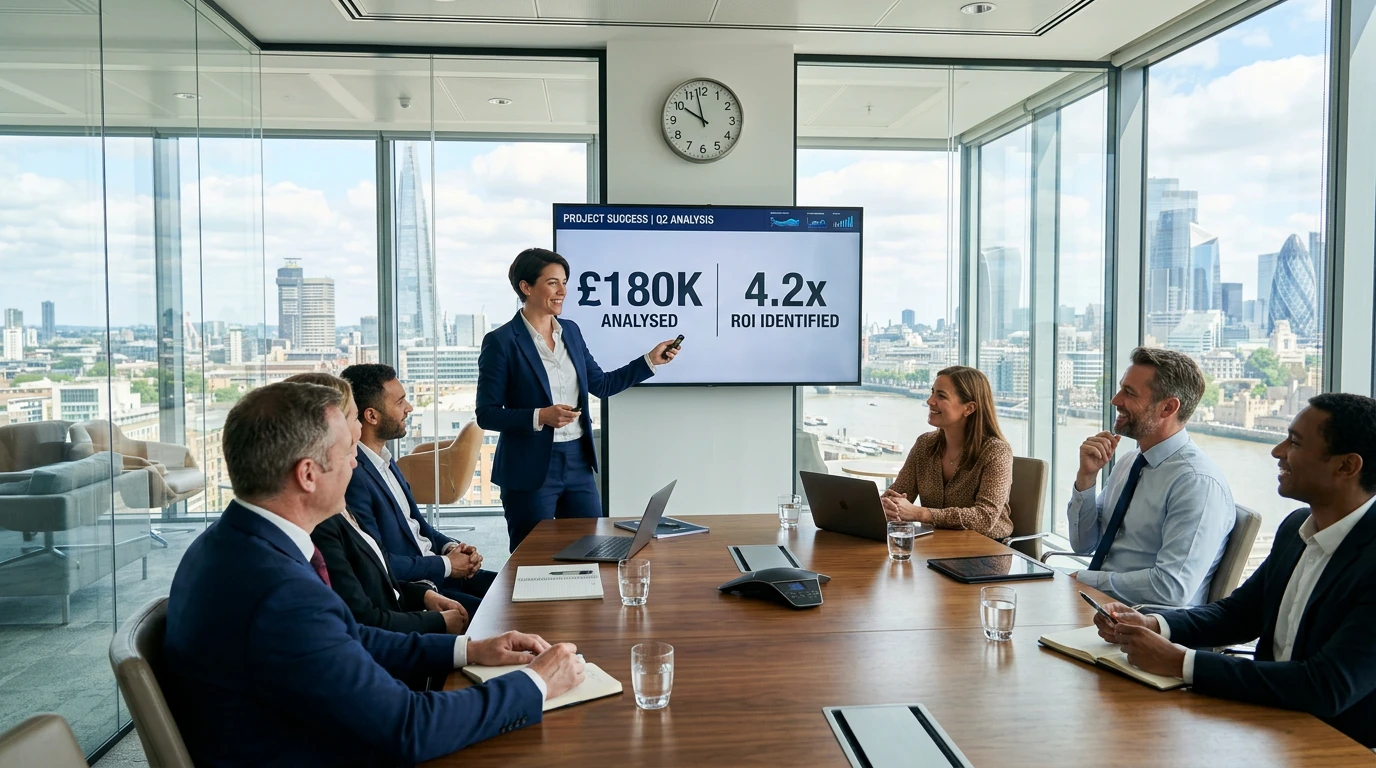
How a CMO Ran a £180K Campaign Post-Mortem in 20 Minutes
EmberBet is a UKGC-licensed multi-vertical operator headquartered in London, serving roughly thirty thousand monthly active players across sports betting and casino. The platform generates approximately £10M per week in GGR, with a brand built largely on the strength of seasonal horse racing promotions — Grand National weekend being the single biggest marketing moment of the year.
Products used: Campaign Analytics, Creative Performance, Player Quality Scoring
20 minutes | £180K spend fully analysed
4.2x ROI | identified across the retained-player cohort
2 channels | paused immediately after the post-mortem
Challenge
Grand National weekend is not a normal promotion for EmberBet. It is, by a significant margin, the most expensive marketing event of the quarter — £180,000 spread across paid social, affiliates, email, and influencer partnerships over five days. The board expects a thorough debrief by noon on Monday. Lena Eriksson, EmberBet's Marketing Director, had roughly four hours.
Before Gaming Mind AI, those four hours were brutal. Campaign data lived in three separate platforms — the paid social dashboards, the affiliate network portal, and the CRM — and none of them spoke to each other. Pulling FTD counts from affiliates, cross-referencing them against deposit values from the CRM, and then calculating D7 retention by creative meant hours of spreadsheet work that invariably contained at least one reconciliation error. Lena had learned to build a two-day buffer into post-mortems so the data team could QA the numbers before they reached the board. There was no such buffer this time.
"We spend more on Grand National week than the rest of April combined. And every year, I walk into that Monday debrief holding numbers I'm not entirely confident in, because I've stitched them together manually in four hours. The board asks one question I haven't pre-answered and the whole story unravels."
— Lena Eriksson, Marketing Director, EmberBet
The deeper problem was player quality. Headline CPA figures were easy enough to pull, but they masked enormous variation in who each channel was actually delivering. A £40 CPA from an affiliate might represent a high-value bettor who'd still be active at day thirty; a £38 CPA from paid social might represent someone who claimed the free bet and churned the same afternoon. The two numbers looked almost identical. The businesses they represented were not.
Solution
Lena opened Gaming Mind AI at 8:42am on Monday with the Grand National campaign wrapped and all five days of data ingested. She had a board presentation to complete, two underperforming channels she suspected but couldn't prove, and a room full of executives expecting a clear-eyed answer to a single question: was it worth it?
Here's how the conversation unfolded:
Lena: "Give me the Grand National campaign overview — total spend, FTDs, revenue, and headline ROI."
| Metric | Value |
|---|---|
| Total campaign spend | £180,000 |
| Campaign duration | 5 days (Grand National weekend) |
| Total FTDs acquired | 1,847 |
| Blended CPA | £97 |
| Same-period gross revenue | ~£342,000 |
| Gross ROI (same-period) | 1.9x |
| Recommended metric | 30-day retained-player value (flagged by Gaming Mind) |
⚠️ Gaming Mind flags: Same-period revenue is the wrong metric for a retention-dependent sportsbook. The 1.9x gross ROI dramatically understates performance for high-quality channels and conceals the loss on poor-quality ones. Rebuilding around 30-day retained-player LTV will split this campaign in two.
The first number that stood out was not the ROI — it was the FTD count. EmberBet acquired 1,847 first-time depositors over the five-day campaign, against a total spend of £180,000, landing at a blended CPA of £97. On raw revenue from those five days — deposit bonuses, race day turnover, and immediate GGR — the campaign returned 1.9x spend. But Gaming Mind flagged immediately that same-period revenue was the wrong metric for a retention-dependent sportsbook. It recommended rebuilding the ROI figure around thirty-day player value, and offered to pull projected LTV for each acquisition cohort by channel.
Lena: "Show me the channel breakdown — paid social, affiliates, email, and influencer. CPA and D7 retention for each."
| Channel | FTDs | CPA | D7 Retention | Est. 30-Day NGR / Player | Assessment |
|---|---|---|---|---|---|
| Email re-engagement | 612 reactivated | ~£0 incremental | 61% | £124 | 🟢 Best performer |
| Affiliates | 714 | £74 | 44% | £98 | 🟢 Strong |
| Paid social | 391 | £112 | 27% | £54 | 🟡 Marginal |
| Influencer partnerships | 130 | £218 | 19% | £31 | 🔴 Negative net revenue per player after bonus costs |
| Total / Blended | 1,847 | £97 | 38% | — | — |
⚠️ Gaming Mind flags: The influencer channel will generate negative net revenue per acquired player once bonus costs are factored in. At £218 CPA and 19% D7 retention, this spend is functionally a brand awareness buy — not a player acquisition spend — and should have been budgeted and measured accordingly.
This is where the campaign split in two. Email re-engagement and affiliates told a strong story: email drove 612 reactivated players at effectively zero incremental CPA, with a 61% D7 retention rate among those who deposited — the highest of any channel by a wide margin. The affiliate network delivered 714 FTDs at a £74 CPA with 44% D7 retention. Paid social and influencers were the inverse: paid social brought 391 FTDs at £112 CPA with 27% retention, and the influencer partnerships produced 130 FTDs at £218 CPA with a D7 retention rate of just 19%. Gaming Mind projected thirty-day NGR per cohort based on historical retention curves and flagged that the influencer channel would, on current trajectory, generate negative net revenue per acquired player once bonus costs were factored in.
Lena: "Which creatives actually converted — and which ones converted the right players?"
| Rank (Player Quality) | Creative | Format | CTR Rank | FTD Conv. Rank | Avg D7 Deposit Value | Notes |
|---|---|---|---|---|---|---|
| 1 | Odds-comparison static — lapsed account holders | Static | 6th | 4th | £114 | Best on player quality; targets 60-day inactives |
| 2 | Racing tips carousel — form guide focus | Carousel | 3rd | 3rd | £96 | Solid conversion and quality |
| 3 | Live odds update story | Story | 4th | 5th | £88 | Good intent signal |
| 4 | Behind-the-scenes jockey video | Video | 2nd | 8th | £71 | High CTR; mid quality |
| … | … | … | … | … | … | … |
| 11 | High-excitement race-day video A | Video | 1st | 2nd | £47 | Highest CTR; attracted browsers not bettors |
| 13 | High-excitement race-day video B | Video | 2nd (tied) | 1st | £43 | Same pattern — top CTR, bottom quality |
| 14 | Generic free bet banner | Static | 14th | 14th | £38 | Worst on all metrics |
⚠️ Gaming Mind flags: Click-through rate and player quality are weakly correlated in EmberBet's paid social data. The two highest-CTR creatives ranked 11th and 13th on D7 deposit value. The odds-comparison static ad — ranked 6th on CTR but 1st on player quality — is the creative to rebuild future campaigns around.
EmberBet ran fourteen distinct creative variants across the paid social campaign — video, static, carousel, and story formats across two platforms. Gaming Mind separated click performance from player quality, and the gap was significant. Two video ads generated the highest click-through rates on the campaign but ranked eleventh and thirteenth on D7 deposit value — they attracted browsers, not bettors. The strongest creative on actual player quality was a static ad featuring a specific odds-comparison message targeting existing account holders who hadn't deposited in sixty days. It ranked sixth on CTR but first on average D7 deposit value at £114 per retained player. Gaming Mind identified this creative as the one to rebuild future campaigns around.
Lena: "Walk me through the FTD quality analysis. What are these new players actually worth?"
| Channel | Total FTDs | High LTV (>£180 / 12-mo NGR) | Medium LTV | Low LTV | 21-Day Projected Churn |
|---|---|---|---|---|---|
| Email re-engagement | 612 | 51% | 36% | 13% | 9% |
| Affiliates | 714 | 38% | 41% | 21% | 18% |
| Paid social | 391 | 24% | 37% | 39% | 44% |
| Influencer partnerships | 130 | 11% | 32% | 57% | 73% |
| Blended | 1,847 | 35% | 38% | 27% | — |
⚠️ Gaming Mind flags: The influencer cohort is stark — only 11% high-LTV, 57% low-LTV, and Gaming Mind projects 73% of that cohort will be inactive within 21 days. At £218 CPA and a 21-day churn window, the influencer spend was a brand awareness buy, not player acquisition.
Gaming Mind scored all 1,847 FTDs against EmberBet's historical LTV model within the conversation. The affiliate cohort skewed high: 38% of affiliate FTDs landed in the top LTV tier — players predicted to generate more than £180 in net revenue over twelve months. The email reactivation cohort was even cleaner at 51% high-LTV, which was expected given these were lapsed players with a known betting history. Paid social was split roughly evenly across tiers. The influencer cohort was stark: only 11% high-LTV, 57% low-LTV. Gaming Mind cross-referenced the low-LTV influencer FTDs against the platform's churn curve and projected that 73% of that cohort would be inactive within twenty-one days. At £218 CPA and a 21-day churn window, the influencer spend was functionally a brand awareness buy — not a player acquisition spend — and should have been budgeted accordingly.
Lena: "What's the real ROI when I build it on retained players only?"
| Metric | Gross (All Players) | Retained Players Only |
|---|---|---|
| Players included | 1,847 | 1,106 |
| Spend attributed | £180,000 | £118,000 (excl. influencer + poor paid social) |
| Projected 30-day NGR | £342,000 | £756,000 |
| ROI | 1.9x | 4.2x |
| Influencer + poor paid social spend | — | ~£62,000 (contributed near-zero retained value) |
| True ROI on channels that worked | — | ~7x on their allocated spend |
⚠️ Gaming Mind flags: Approximately £62,000 of total spend — the influencer budget and roughly a third of paid social — contributed almost none of the retained player value. The true ROI on the channels that worked is closer to 7x. The 1.9x gross number obscures both the best and worst performers.
When Gaming Mind stripped out the players Gaming Mind's own churn model flagged as near-certain to be inactive by day twenty-one — the cohort that would never convert to meaningful GGR — the campaign ROI restructured completely. The retained-player cohort of 1,106 players across affiliates, email, and the better-performing paid social segments was projected to generate £756,000 in thirty-day NGR against the £180,000 spend, arriving at a 4.2x ROI on actual retained value. The caveat was that roughly £62,000 of the total spend — the influencer budget and roughly a third of paid social — contributed almost none of that retained value. The true ROI on the channels that worked was closer to 7x on their allocated spend.
Lena: "How does this compare to our last two major racing promotions?"
| Campaign | Date | Total Spend | FTDs | Blended CPA | D7 Retention | 30-Day NGR | Retained-Player ROI | Influencer Spend |
|---|---|---|---|---|---|---|---|---|
| Cheltenham 2024 | March 2024 | £112,000 | 1,140 | £98 | 34% | £348,000 | 3.1x | £8,000 |
| Royal Ascot 2024 | June 2024 | £148,000 | 1,510 | £98 | 37% | £562,000 | 3.8x | £18,000 |
| Grand National 2025 | April 2025 | £180,000 | 1,847 | £97 | 38% | £756,000 | 4.2x | £28,000 |
⚠️ Gaming Mind flags: The influencer spend has grown from £8,000 at Cheltenham to £28,000 at Grand National while consistently underperforming on every quality metric across all three events. This pattern has been present in the data for 12 months. It was not a new problem — it was a visible problem that had never been laid out in one conversation before.
Cheltenham in March 2024 delivered a 3.1x retained-player ROI. Royal Ascot in June ran at 3.8x. Grand National came in at 4.2x — a measurable step up, and one Gaming Mind attributed primarily to the affiliate channel improvements made after Cheltenham and the email reactivation programme that launched ahead of Ascot. What the comparison also showed was that the influencer spend had grown from £8,000 at Cheltenham to £28,000 at Grand National, while consistently underperforming on every quality metric across all three events. The pattern was not new. It had been present in the data for twelve months.
Lena: "Give me a board-ready summary: what worked, what didn't, and what to do for Royal Ascot."
| Section | Detail |
|---|---|
| Finding 1 | Grand National delivered 4.2x ROI on retained players — best racing campaign by a clear margin |
| Finding 2 | Affiliate quality and email reactivation drove the performance; influencer and low-performing paid social did not |
| Finding 3 | Influencer spend has underperformed on player quality across all 3 major racing promotions — the pattern was in the data for 12 months |
| Immediate action 1 | Pause influencer partnerships — pending budget reallocation review |
| Immediate action 2 | Pause lower-performing paid social variants — frees ~£42,000 for Royal Ascot reallocation |
| Royal Ascot rec. 1 | Double affiliate budget — highest retained-player ROI channel |
| Royal Ascot rec. 2 | Rebuild paid social creative around odds-comparison message (ranked 1st on D7 deposit value) |
| Royal Ascot rec. 3 | Reposition influencer as brand awareness with separate measurement criteria — or remove from performance budget entirely |
⚠️ Gaming Mind flags: Two channels should be paused immediately. The £42,000 freed up represents nearly a quarter of the total Grand National spend — reallocating it to affiliates and email for Royal Ascot is the clearest high-confidence action from this post-mortem.
Gaming Mind produced a three-section summary Lena pasted directly into her presentation deck. The Grand National campaign delivered a 4.2x ROI on retained players, driven by affiliate quality and email reactivation. Two channels — influencer partnerships and the lower-performing paid social variants — should be paused immediately pending a budget reallocation review. For Royal Ascot, Gaming Mind recommended doubling the affiliate budget, rebuilding paid social creative around the odds-comparison message that had ranked first on D7 deposit value, and repositioning influencer spend as brand awareness with separate measurement criteria — or eliminating it from the performance marketing budget entirely.
Results
Board presentation complete by 11am, not noon
Lena walked into the board room at 11:07am with a complete, data-backed campaign debrief — fifty-three minutes early. She had channel-level ROI, player quality scores, historical comparisons, and three concrete recommendations for Royal Ascot. The presentation ran twenty-two minutes. Nobody asked a question she didn't have an answer for.
Two underperforming channels paused the same morning
The influencer partnerships and lower-performing paid social variants were paused before end of day Monday, freeing up an estimated £42,000 in earmarked Royal Ascot budget for reallocation to affiliates and email. The decision was made in the room, on the same day, rather than waiting two weeks for a data team report.
The real ROI story changed how the board reads campaigns
Before Gaming Mind, EmberBet's post-mortems reported gross CPA and same-period revenue — figures that routinely made campaigns look more efficient than they were. The shift to retained-player ROI as the primary metric reframed how the board evaluated marketing spend. The Grand National campaign was not the most efficient one EmberBet had ever run on gross numbers. On retained-player value, it was the best by a clear margin — and that distinction now has a name and a methodology.
One creative insight will reshape future campaign builds
The odds-comparison static ad that ranked first on D7 deposit value despite ranking sixth on CTR became the reference creative for the Royal Ascot brief. Gaming Mind's finding — that click-through rate and player quality were weakly correlated in EmberBet's paid social data — overturned an internal assumption that had driven creative strategy for over a year.
Historical pattern surfaced something leadership had missed
The influencer channel had underperformed on player quality across all three of the last major racing promotions. That pattern was in the data. It had not, until Gaming Mind drew the comparison, been laid out in a form that made the decision obvious. It wasn't a new problem. It was a visible problem that had been invisible because the data lived in three different places and no one had ever pulled it together in the same conversation.
"We've been doing post-mortems for three years. Every time, we'd finish them and think we understood the campaign. What I realised on Monday was that we'd been reading the surface. Gaming Mind went two layers deeper in twenty minutes than we'd ever gone in two days. The influencer spend had never worked — we'd just never proven it clearly enough to stop it."
— Lena Eriksson, Marketing Director, EmberBet
Read in another language
Want to see how Gaming Mind AI can help your operation?
Get a Demo